A clear code. A complete case.
Describe your goods, answer relevant product questions and review a proposed 10-digit import code against live UK tariff evidence. Download a PDF of the reasoning, alternatives and source links.
See the work.
Understand the output.
Explore the live product and how it fits into a real working process.
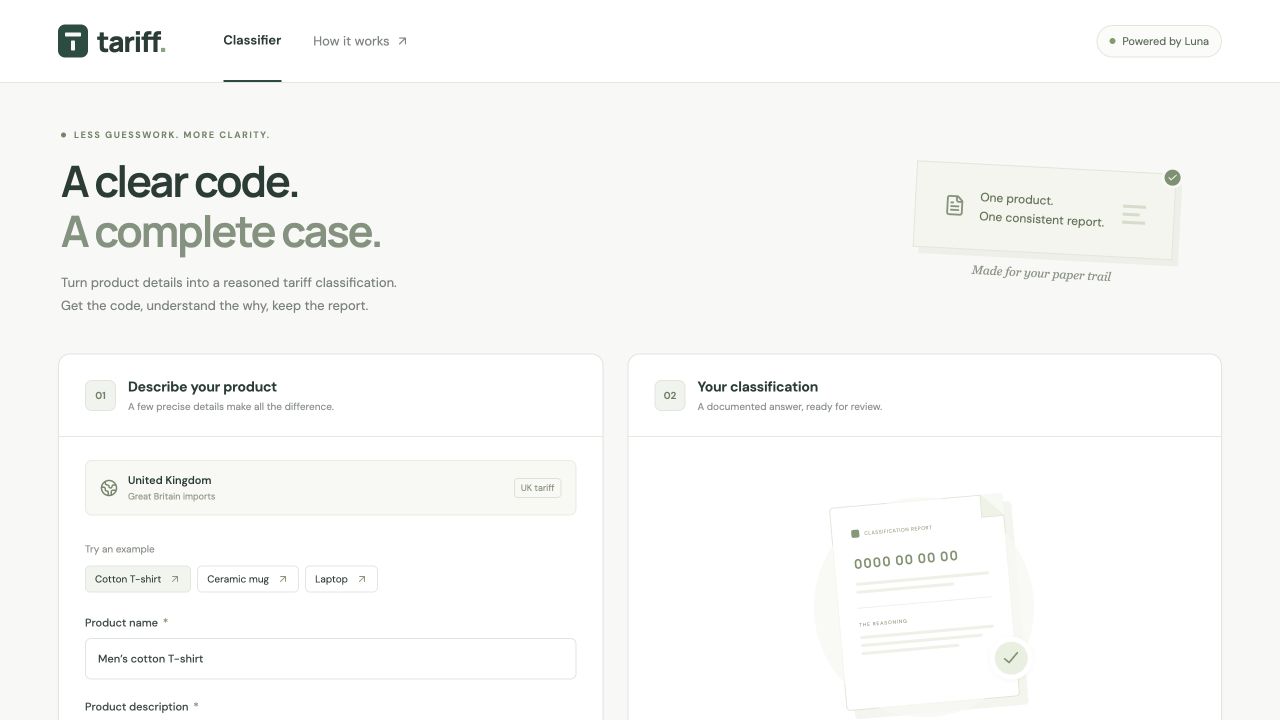
A product description and answers to relevant questions.
A proposed GB import code and a PDF explaining the reasoning and sources.
Confirm the facts and review the classification. Duty, VAT and Northern Ireland are outside this tool’s scope.
Choose a built-in example to see how product details are entered.
Built around a clear purpose.
Sometimes the task is focused: work through the relevant product questions, review a proposed import code and keep a clear explanation.
- Work through relevant product questions
- Review a proposed 10-digit GB import commodity code
- Download an A4 PDF with facts, reasoning and dated sources
How it fits into the work.
- 01
Describe the product
Describe the goods and the product details you already know.
- 02
Answer the questions
Answer the relevant follow-up questions to narrow the classification.
- 03
Download the report
Review the proposed code and download the supporting report.
A proposed 10-digit GB import commodity code and an A4 PDF covering the facts, reasoning, alternatives and dated source links.
See a practical
use case.
A representative workflow, the inputs to bring and measures you could use to judge a pilot.
Useful questions.
Clear answers.
What does the tool produce?
A proposed 10-digit Great Britain import commodity code and an A4 report explaining the reasoning, alternatives and sources.
Why does it ask follow-up questions?
Details such as what a product is made of or how it is used can matter to classification. The questions help clarify relevant facts.
Does it calculate the total import cost?
No. Its focus is GB import classification. Duty, VAT, origin-specific measures and Northern Ireland are outside its scope.
A tool is part of the answer.
DAIS can help you explore the fit, agree the setup and support the people who will use it.
Bring your product
and purchasing work together.
Explore ChainMap and OrderFlow with us, and find the right starting point for your team.